

Funding the future of local news
After decades of local news in decline, and the impact this is having communities, help is finally coming.
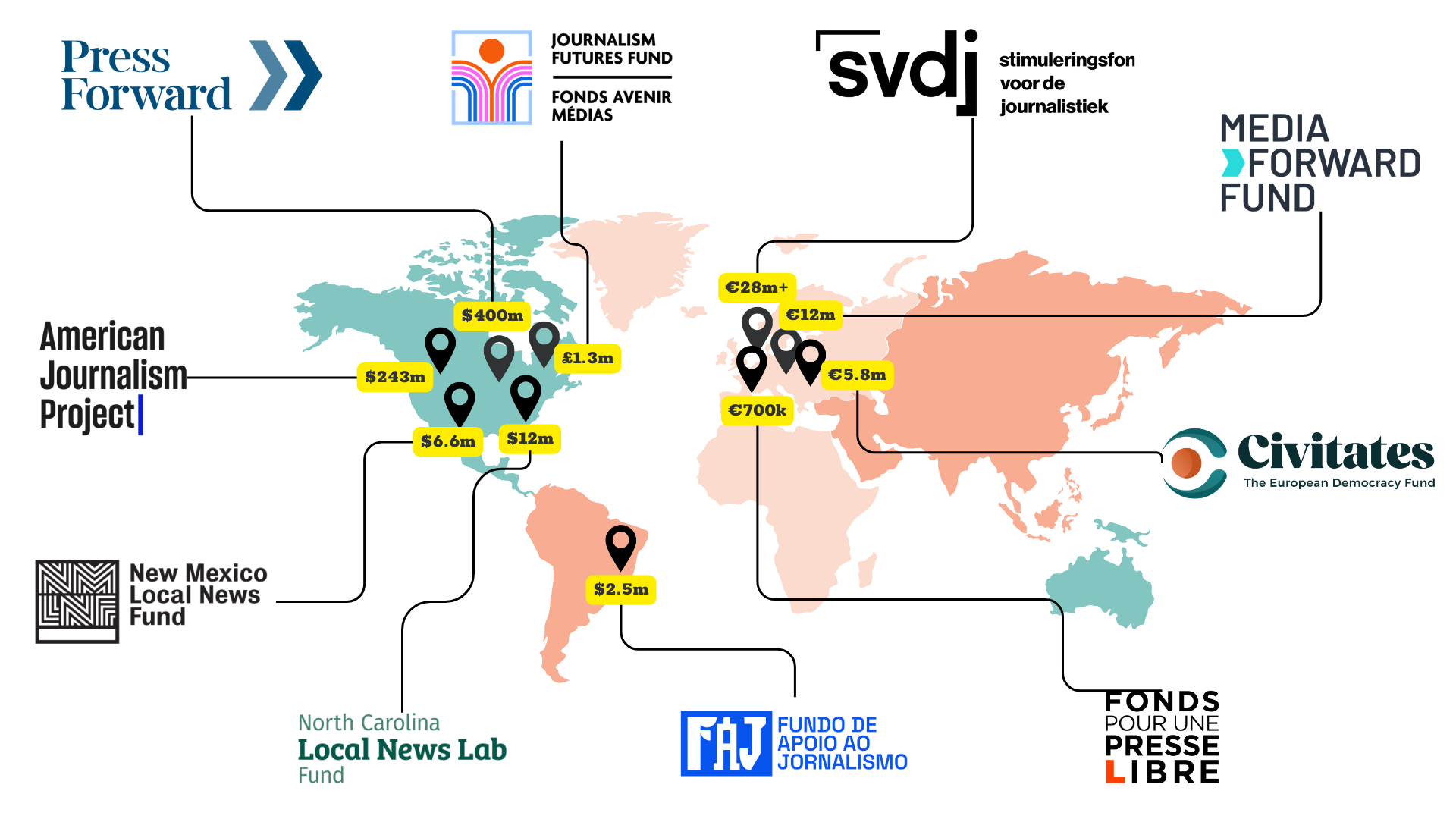
Recognising that local news is essential social infrastructure, coalitions of funders across the world are coming together to create bold new funds to support its revival.
Mobilising hundreds of millions of dollars, they are helping to develop the sector’s capacity to sustain itself through new business models, revenue streams, and value for communities, building a foundation for journalism to flourish in the long term.
Based on interviews with leaders from funds across the world, this report features 10 in-depth case studies, and provides comprehensive evidence on how journalism funds are revitalising news that matters to communities.
This report documents what works, why it works, and sets out a practical blueprint for building a local news fund in the UK, and beyond.
A global wave of journalism funds is rising to support a revival of local news.
This new in-depth report documents how they work, they impact they’re having and the lessons for others to follow.

Five key findings
1. This is growing new movement
The majority of these funds have been founded since 2019. There is a striking convergence in their models, both in how they build funder coalitions in order to bring catalytic funding into the sector, and how they are having a meaningful impact in addressing the underlying market failure, and its impact on communities and democracies.
There is a deep alignment in their missions, philosophies and values, their governance structures, and theories of change.
2. They are highly strategic
These news funds are helping to develop the sector’s capacity to sustain itself through new business models and revenue streams, building a foundation for journalism to flourish in the long term.
They provide flexible, catalytic funding, and capacity building support to support concrete plans for newsrooms to develop viable business models.
These funds also recognise that innovation doesn’t happen in a vacuum. They consciously work to strengthen the whole ecosystem of innovative, public interest newsrooms, rather than just individual organisations.
3. They care about social impact
Funders are supporting journalism not to save the news industry, but to save democracies and strengthen communities.
Journalism funds ultimately care about the social impact that the newsrooms they support create. This means selecting for organisations that have the best potential to achieve durable social impact with funding.
This means ethical, independent, mission-driven organisations that have a proven commitment to advancing the public good through their journalism, and have the capability and ambition to grow their sustainability and impact.
4. They are effective collaborative vehicles
Funders from philanthropy, government, impact investment and lotteries are pooling their expertise and resources, providing a systemic response to a systemic challenge.
These funds are raising millions of pounds often in less than two years, providing a low barrier to entry for new journalism funders, while reducing their collective costs and risks.
Through pooling resources and delegating decisions to independent expert juries they distance individual funders from individual news organisations, creating a firewall that protects the editorial independence of the newsrooms they support.
These are also effective spaces for building knowledge and expertise, with expert teams running the funds, as well as a space for funders to learn about how best to support journalism.
These journalism funds are already seeing the impact of their investments. News organisations are growing and diversifying their revenue streams, creating models for others to follow.
They have established clear strategies, governance and support. The revival of local news will not happen overnight, but journalism funds provide crucial foundational infrastructure to make it happen.
There is no need to reinvent the wheel. Taken together, these journalism funds provide a blueprint for other countries to follow.
5. They provide proven, replicable models
Ten steps to build a local news fund
1. Start by listening
Don't guess what newsrooms need. Take a bottom up approach to be genuinely led by the needs of the field. Launch a listening tour and embed the voice of the field within the organisation.
2. Co-design the fund
Involve a coalition of founding funders from day 1. It creates a stronger fund, with shared ownership and an aligned strategy. This coalition is necessary to create the gravity needed to attract others.
3. Build the firewall into the foundations
Protecting editorial independence must be structurally built into the fund. Create distance between the source of funding and grantees, such as through independent juries, and pooling funding.
4. Build a pooled fund
Pooled funds are both effective and necessary, providing an ecosystem approach to an ecosystem problem. They bring in more capital, provide a space for learning and coordination, & reduce risk.
5. Fund the business engine to support the journalism
To solve the market failure at the core of the crisis for local journalism, a fund should invest in the business behind newsrooms, rather than journalism itself. A UK fund should direct its funding towards building the operational and revenue capacity of newsrooms.
6. Provide catalytic funding
Grants must be large enough to be transformative. A UK fund should provide multi-year catalytic funding that gives newsrooms runway to transform and grow their resilience and revenue.
7. Provide responsive capacity building support
Money alone is not enough. It needs the skills and capacity to put it to work. A UK fund should pair funding with coaching and peer networks. It should be flexible and responsive to their needs.
8. Prioritise ambition, equity and public good
A new fund should carefully consider who to fund based on its ecosystem listening. It should address the greatest needs and select for those with the greatest potential to create social impact in the most durable way.
9. Build the field
The fund should view itself as a field builder, supporting the whole ecosystem’s capacity to innovate.
This means supporting and collaborating with other journalism support organisations, and building shared infrastructure that lowers the cost of doing business for the entire sector.
10. Start now, and learn by doing
The need for a UK local news fund is urgent. At the same time the best way to learn how to be effective is to launch and test. A UK fund’s strategy should be emergent.
It should start now.
